The Supreme Ugandan Shadow Director

One dark night, two men are walking home after a party and decide to take a shortcut through a cemetery. Right in the middle of the cemetery they are startled by a tap-tap-tapping noise coming from the misty shadows. Trembling with fear, they find an old man with a hammer and chisel, chipping away at one of the headstones.

“Walalala!” one says after catching his breath. “You scared us half to death. We thought you were a ghost! What are you doing, working here so late at night?”  “Those fools!” the old man grumbled. “They misspelled my name!”

Last month, our Ugandan brethren were caught up in a governance kerfuffle involving the highest office in the land. In early July 2022, the Board of Uganda Airlines appointed Ms. Jennifer Bamuturaki as the new Chief Executive Officer. Actually, that’s not true. According to an East African newspaper article published on July 7th that reported the appointment, what really happened was that on July 5th the chairperson of the airline’s Board received a letter from the Minister for Works and Transport, General Katumba Wamala. The letter informed the Board Chairperson that Ms. Bamuturaki, who up until minutes before the letter was received had been serving as interim CEO for more than a year, had been appointed as the substantive CEO.

The good General wasn’t trying to take one for the team. He shone a bright light into the misty governance shadows and stated that it really wasn’t his idea and that actually, the directive had come from the permanent occupant of Uganda’s State House back in April. The East African article doesn’t delve into why it took the Minister another three months to act on said directive, but we are not here to question the slow grinding wheels of bureaucratic execution. And neither was the Ugandan Parliament interested in that time lapse. What they were interested in was how in heaven’s name someone who didn’t apply for a job get it in the first place? Moreso since the globally renowned firm PwC had been appointed by the airline’s Board to spearhead the recruitment of the CEO and the process was still ongoing.

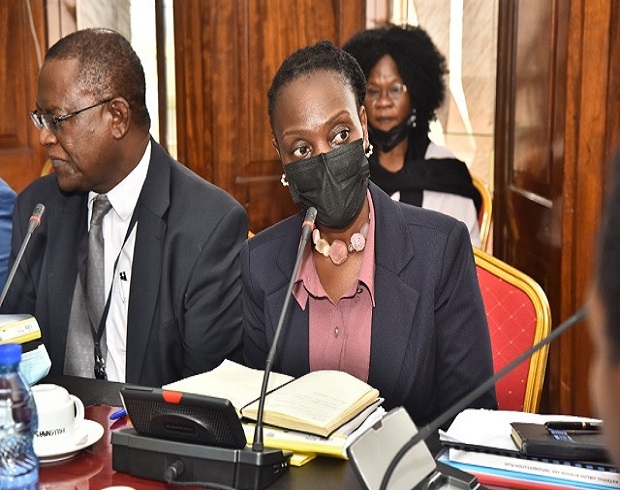
So on August 17th  2022, Ms. Bamuturaki appeared before the Parliamentary Committee on State Authorities and State Assets to answer questions about her appointment. The Committee found that she did not have the minimum academic qualifications required for the job as advertised by PwC, but found that her 15 years of experience surpassed the 10 years required on the advert. After flexing their legislative muscle and making all the requisite noises (Kenyan jurists might call it hot air and somewhat of a wild goose chase) required for their constituents to know that they were hard at work, that was it. The good lady continues to lead the airline and life moves on as it very well should.

What the State House occupant did was to direct the Board from the shadows. The interesting thing is, under company law anyone who provides direction from the shadows can be dragged out into the light to attract the same kind of liability as a substantive director in the event you-know-what hits the fan. They are called a shadow director. Section 2 of the Ugandan Companies Act defines it quite explicitly by stating that a director includes any person occupying the position of director by whatever name called and shall include a shadow director. The Kenyan Companies Act gives a little more illustration on what this shadow directorship looks like. While not expressly using the word “shadow director” section 3 provides that a director is any person who a) occupies the position of a director by whatever name the person is called and b) any person in accordance with whose directions or instructions the directors of a company are accustomed to act. Such advice excludes that coming from a professional capacity such as lawyers or auditors for example.

The good General who is the line Minister already set the trend for the Board in case of any trouble that may emerge ahead. He pointed his finger upstairs and said in the immortal words of Shaggy, the reggae singer, “It wasn’t me”. In the unlikely event the Board of the airlines is ever in the dock for corporate malfeasances due to the acts or omissions of the CEO, they too can sing in unison “It wasn’t us” while being left solo at the lights of presidential immunity.

[email protected]

Twitter: @carolmusyoka

Shadow Directors

Maneno Ltd is a Nairobi Stock Exchange Listed company in the business of manufacturing consumer products. The founder, Michael Monga, was a well-respected businessman with multiple interests in various industries some of which interests have led to obvious potential conflicts. As Monga was quite alive to the effect of negative publicity on his business interests, he often appointed proxies to the boards of companies in which he was a substantial owner. Maneno Ltd had three such directors, who were senior employees in Monga’s other companies. Monga, being a very shrewd player, was also careful to select independent non-executive directors that could be prevailed upon to play ball where required.
Due to a fairly loose enforcement regime, cheap imports of the same consumer products that Maneno manufactured had started to flood the Kenyan market and management were spending valuable time firefighting with the relevant government agencies. Prudent past management had ensured that a significant amount of cash had been set aside and invested in money market instruments in anticipation of a strategic plant expansion that had been planned in the 5 year strategy. Monga instructed his three directors to support the Managing Director’s board paper recommending an interim dividend. That seemed strange as the financial projections indicated that the company was going to make a loss that year due to shrinking sales. The paper was approved and a special dividend was paid. The company went ahead to make losses and the following year a hefty final dividend was declared that essentially wiped out the healthy cash reserves that Maneno had been holding. As sordid stories go, within no time Maneno was bleeding cash, as management was unable to stem the effect of cheap imports versus their own locally manufactured products in an aging plant with high labor costs. The company filed for insolvency within two years of the final hefty dividend payout.
What potential remedies exist for the minority shareholders who were held at glorious ransom by the corporate shenanigans of Michael Monga? Both Kenya and Uganda have recently revamped their company laws from the archaic 1948 UK Companies Act that formed the basis of local company law. Uganda passed the Companies Act 2012 and Kenya followed suit with the Companies Act 2015 both of which laws essentially aligned company law with modern norms such as the concept of a shadow director. Company law defines a shadow director as someone who has not been formally appointed as a director but in accordance with whose directions or instructions the directors of a company are accustomed to act.
If you’re struggling to picture one, think of a multinational company in Kenya, whose board is regularly instructed by “group” via the managing director, on when to declare dividends or when to postpone making critical provisions on their financial statements. It can also be the finance director of a Kenyan company that has regional subsidiaries and demands the same financial behavior of the subsidiary boards. [It bears noting that the Tanzanian Company Act 2002 does not expressly define shadow directors.] It can be a cabinet secretary who regularly issues instructions to the board of a limited liability company with significant government ownership. In the Maneno Ltd example, Michael Monga is a classic example of a shadow director. Not only was he giving express instructions to the non-executive directors, but he also ensured that he indirectly controlled the board through the appointment process. For all intents and purposes, Monga was the board.
Company law recognizes that while de jure directors (directors by law) have fiduciary duties to the company including the duty to act in the best interests and promote the success of the company, de facto directors (directors in fact) also owe the company fiduciary duties and can therefore be held accountable for their acts in the same vein as the directors on record. This premise was established in the 2013 landmark United Kingdom case of Vivendi SA and Centenary Holdings Ltd versus Murray Richards and Stephen Bloch. In the case, as succinctly summarized on the Helix Law website, a shareholder of a company in trouble used his influence to make the sole director of the company pay him a salary and other money from the company, without providing any benefit or services back. These payments were made while the company was insolvent. The company went into liquidation and its receiver claimed compensation from the shareholder claiming that a) he was a shadow director b) a shadow director owed the company fiduciary duties as if he had been formally appointed as a full de jure director and c) the shareholder had breached those duties. A Burges- Salmon blog on the shadow director subject matter summarized the court’s findings thus: On the first issue, the court found that the sole director was accustomed to acting in accordance with the shareholder’s instructions and therefore the shareholder satisfied the test for shadow directorship. On the second issue it was found that in giving instructions to de jure directors, a shadow director assumed responsibility for a company’s affairs. However while a shadow director’s duties were not statutorily provided for, the consequences of being found to be a shadow director must evidence Parliament’s perception that a shadow director could bear responsibility for a company’s affairs. The court also observed that a shadow director’s role in a company’s affairs might be just as significant as a de jure director, and that public policy pointed towards statutory duties being imposed on shadow directors.
What does this mean for Michael Monga and many like him?
Company Law now provides extraordinary personal consequences to the shadow director including: a liability to contribute to the company’s assets following the company’s insolvency, disqualification from being a director of any company in Kenya following the company’s insolvency as well as criminal sanctions and personal liability for violations of director’s duties.
As a parting shot, while de jure directors may rely on Directors and Officers insurance cover, the shadow director is most definitely not covered under the same. If you sit on a Kenyan or Ugandan board, now would be a good time to look over your shoulder and find those shadows.
[email protected].
Twitter: @carolmusyoka[/vc_column_text][/vc_column][vc_column width=”1/3″][/vc_column][/vc_row]