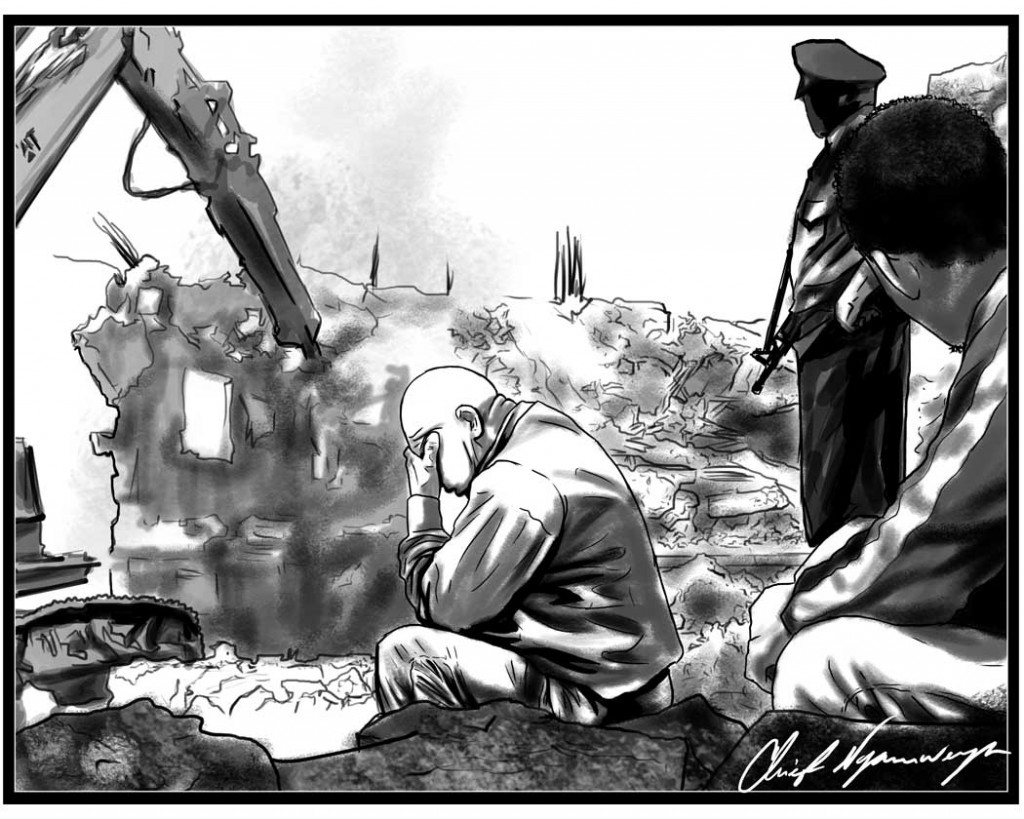
Syokimau Demolitions

The insurance industry has to have some of the most imaginative clients in the service industry when it comes to making insurance claims. Using excerpts from claim forms, here are the top five most creative causes of accidents.

Number 5: “The accident happened because I had one eye on the lorry in front, one eye on the pedestrian and the other on the car behind.”

Number 4: “I started to slow down but the traffic was more stationary than I thought.”

Number 3: “I didn’t think the speed limit applied after midnight”

Number 2: “I knew the dog was possessive about the car but I would not have asked her to drive it if I had thought there was any risk.”

And the number one most creative reason for an accident: “Coming home I drove into the wrong house and collided with a tree I don’t have.”
I’ve been watching the gut-wrenching saga going on with the Syokimau demolitions and have concluded that the flip flops being undertaken by all the concerned government agencies are as good as insurance claimants:

“The land which was ours, was taken away by those guys who then sold it to those other guys and then we woke up and it was a dream.”

I am confident of one thing: we will never find out what truly happened, our moral outrage will fizzle with time and be reignited by yet another – yawn – scandal of volcanic soil proportions and only the homeless Syokimau families will remain with the painful scars.

I bought land in Syokimau. Oh yes, I am a victim of the must-buy-land-now-in-a-good-deal frenzy. It was in the dimming light of the year 2002. A close relative told me about how Uungani Settlement Scheme Self Help Group (USSSHG) had a huge parcel of land in Syokimau and only members would get land allocations. I went, I saw and I conquered. I paid Kes 2,000/- for shares and another non-refundable fee of Kes 1,500 as membership. Four months later in April 2003, I then paid a deposit of Kes 13,000 into a bank account for my half-acre plot number 851. Who wouldn’t pay for a half-acre being sold for Kes 35,000/-! This was followed by total silence.

2003 rolled by and we were told to wait. 2004 rolled by and we were told to wait. 2005 rolled by and we were told to- you guessed it – wait. In October 2006, I received a letter signed by the Chairman and the Secretary of USSSHG giving a written account of the project status update. The letter played back the discussions and revelations that had taken place at a General Meeting of the group in July 2006.

It turned out that there had been a case pending in the High Court between USSSHG and the Kenya Airports Authority that had been filed by the latter in the year 2003. [What?!] The letter stated in part “ The lawyer for our group….informed members that the case has collapsed and encouraged us to proceed on with our development projects and to pursue the title deed for the whole parcel of land, which in any case is in Mavoko Municipality and not part of the JKIA, which is in Nairobi Province.” [Pardon ?!]

So my brain spark plugs began firing. This deal of a half acre for Kes 35,000 is on disputed land? Which land has been claimed by a government agency? Hit the brakes. I kept on reading. “Members were encouraged to move to their plots, start fencing, plant trees, present their building plans to our offices for approval by the Planning and Development Committee who will also arrange for approvals by Mavoko Municipality.” Put engine on idle. I kept on reading. “Members who have not cleared their outstanding balances were encouraged to pay these balances immediately. A penalty for delay has been imposed on unpaid dues by doubling the amount outstanding on each plot.” Since my outstanding balance was Kes 22,000/- I now owed the princely amount of Kes 44,000/- because of waiting for communication about what the next steps were for THREE years! Furthermore, members were being asked to pay an extra Kes 15,000 for re-survey of the land, replacement of destroyed beacons and payment of rates. Engage reverse gear! The whole deal was starting to smell worse than a skunk I once ran over one late night on the lonely stretch between Syracuse and Ithaca in upstate New York. I bailed out.

But others chose to forge ahead with the project and the result was the growth of a housing development using hard earned savings and borrowings. On the one hand, buyers of the Syokimau plots cannot plead ignorance. The Kenya Airports Authority had laid claim to that land from as far back as 2003. But on the other hand, the Mavoko Municipal Council cannot claim innocence either as they were fully aware that there was a claim on the land by none other than a government agency, court outcomes notwithstanding. Mavoko should not have provided the planning and building approvals with such relish and glee.

What Mavoko Municipal Council has now done is to destroy any modicum of respect, reputation or integrity that was ever accorded to it. Forget what USSSGH did or did not do, or whether it was ill advised by its lawyer. The local authority had the fiduciary responsibility to provide planning approvals on land over which it had legitimate authority as the approvals only served to validate what is now being revealed as fake titles. What this essentially does is to put doubt in anyone’s mind about the veracity of any title issued within the Mavoko Municipality. In my view, the overheated property prices in this area should essentially get a much needed dousing of cold water as they clearly are not worth the paper that their titles are written on. The council’s behaviour is an insurance case of driving into the wrong house and crashing into a tree that you don’t own.
[email protected] Twitter: @carolmusyoka
Why Kenyans Prefer Indian Medical Treatment

Earlier this year I had the opportunity to accompany a close relative for treatment at a well-regarded hospital in Chennai, India. The hospital is part of a chain of hospitals across India and Asia that specialize in providing low cost yet high quality medical services to its customers who consist of both local and international patients.

Apollo Hospitals was started in 1983 by its visionary Chairman Dr. Prathap C. Reddy as a 150-bed hospital. Today, it is part of India’s success story in emerging as a major hub in global healthcare. The group has 5,888 owned and 2.388 managed beds across 36 owned and 14 managed hospitals across Asia. My fascination with the group’s performance simply arose after bearing witness to fast, efficient service delivery at their Chennai hospital having spent many a night at local Kenyan hospitals waiting to be attended to and wondering if this is what my destiny as a human being awaiting medical attention was deigned to be.

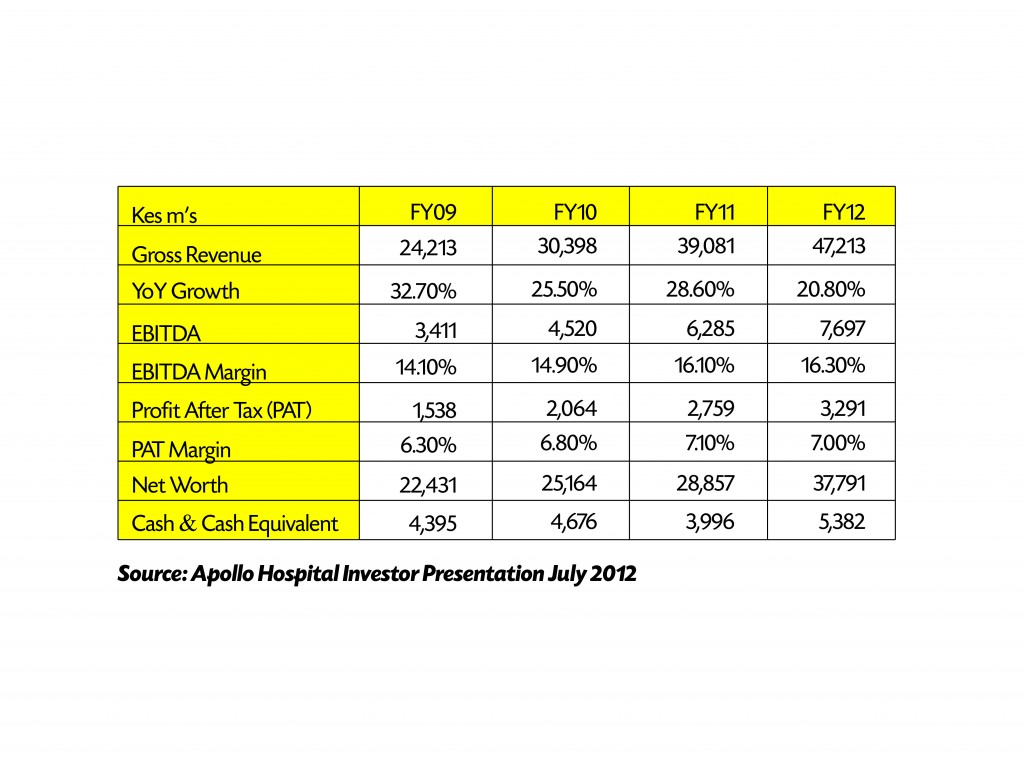
I think we all know that nothing is certain in life except for death and taxes. In view of the fact that it is human nature to try and delay and in most parts avoid the two as much as possible, you can see why both hospitals and tax consultancies are big business. The accompanying table demonstrates the financial success that is the Apollo Hospitals business. Healthy double digit EBITDA margin yields speak to good cost controls that do not destroy the quality of service and the remarkable cash positions provide good working capital buffers that keep the costs of running the business within control.

My personal experience demonstrated to me that it is possible to have good quality medical care at fairly reasonable costs. Of course, it goes without saying that the Indian medical industry has the benefit of sheer numbers which underpin the high volume low value business model. I’ll give them that. But the efficiency of document and information movement has nothing to do with providing low cost medical care rather it’s a service delivery mechanism that ensures very little time is wasted by patients in seeking medical attention.

Here is an illustration: we had set up appointments with about five specialists at different times within 48 hours. At the International Patient Centre, the clerks opened a patient file with all the patient data that we could produce. A blue physical file was produced with a bar code appended to the cover. We were never allowed to touch that file, and it mysteriously appeared at every single appointment we went to because the hospital’s system showed where the next appointment would be and where the patient file should thus be headed. At one appointment, the file had not yet appeared (thank God for small inefficiencies) and the doctor’s receptionist just took the patient’s badge (which everyone gets at the point of signing up) that had the bar code printed above the patient’s name. She scanned the bar code and the system showed her exactly where the file was (under a stack of a million other files at our last appointment) and it was retrieved and brought before we had even entered the doctor’s office. The small glitch allowed me to see their document movement system at work. Once the receptionist had identified the file’s location, she made a call to that office barked a few admonitions in rapid fire Tamil and a small, ferret like minion appeared within minutes, file in hand.

All the doctors’ fees are the princely sum of 500 Indian Rupees equivalent to Kes 750/-, regardless of whether that doctor is the absolute top dog in his or her field of specialization. This is noteworthy as I was in Chennai six years ago in 2006 and the fee was exactly the same amount of rupees then! The result is that one gets attended to by the very best in the field of medicine that one is seeking attention for without worrying about the cost of paying for that experience. It also bears noting that where one is admitted into the hospital, one is cared for by a team of specialists [typically a senior and a junior doctor] No one doctor can treat you alone and it makes for excellent health care as the team collectively decided on the best course of action after vigorous debate and discussion.

I daresay it will be a long time before our private medical services will attain the economies of scale that their Indian counterparts enjoy which allow them to drive volume and keep the prices low. But the local medical industry does have the capacity to improve efficiencies in their service delivery. Those improvements lead to a lower cost of production and should translate into lower prices for medical services. Increasing the volume of treated patients by reducing the time taken from start to finish of a hospital visit would be a good start. This helps to build confidence in patients (customers) that going to hospital to seek medical attention sure beats hunkering down on the sofa and wishing the sickness away.

On a lighter note, every time I entered the Chennai hospital, I would be met by a hospital orderly, face was covered with a mask, and whose sole purpose was to slather antibacterial spray on anyone entering the hospital (before we placed our bags through a security screening machine). This fellow took his job very seriously, until about 1 p.m. when he took his lunch break. At this point, no one would man the bacteria-security point until he returned from his break. I gathered Indian bacteria goes on lunch break too.

[email protected]
Twitter: @carolmusyoka
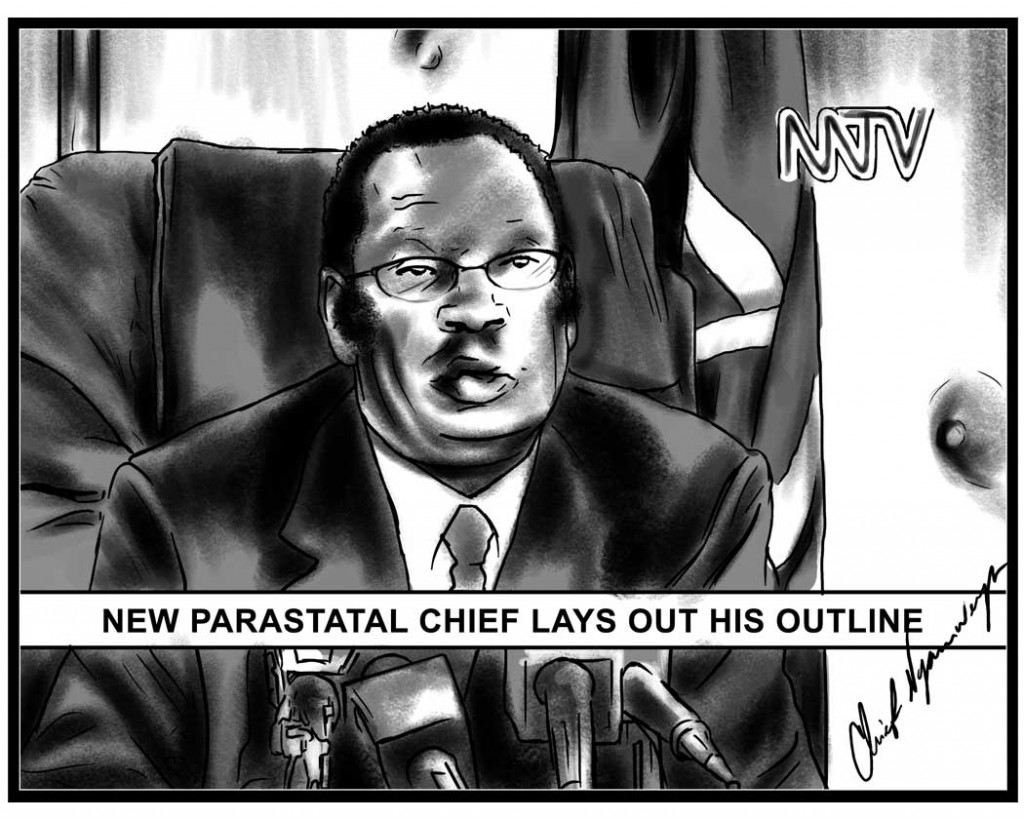
 

Diary of a parastatal CEO part 2

January
Well, this year started with a bang. No really, I mean a real bang. Some thugs attempted to shoot at me as I was driving into my house at the beginning of the month. To say that I was shaken by the event would be an understatement. The CID detective on the case told me that it was definitely work related. He asked me if my organization was undertaking a massive procurement. I asked him why. He looked at me funnily. I then saw the light. I decided two things: firstly, a bodyguard is a necessary but irritating appendage required for this job and secondly, I told my board that I was stepping aside from the procurement committee. That major equipment whose tender closed last December was clearly generating more interest than I could possibly survive. The board bought my story about transparency and accountability being my reasons for stepping aside. Actually one of the directors, Mr. X looked mighty pleased at my announcement. I didn’t care. I now play “Staying Alive” by the Bee Gees every morning as I shave.

February

Why doesn’t someone write a manual on “How to be a successful and healthy parastatal CEO” and give it to all incoming CEOs on their first day? I am getting tired of dodging landmines at each turn. Godfather called me last month as soon as he heard that I had resigned from the procurement committee and let’s just say that all I heard was *&!# after every five seconds. He requested, nay, ordered me to get back on the committee. Apparently there were forces out to scuttle the tender process that was completed in December. He reminded me about his motto: “Us small tribesmen have to stick together”. I told him about the thugs. He told me that he would ensure that I received an additional bodyguard from our small tribe to help the one I already had. Somehow I got the feeling that I didn’t have much choice.

March
I had a very difficult discussion with the Chairman of the board who couldn’t understand my flip-flopping over whether I wanted to be a member of the procurement committee. I told him that my staff had advised that my input was required as the CEO since there was some pressure being laid to bear by some members of the committee who had vested interests. He bought my story. Something fishy happened early this month. On my way back from plot shopping in the plot rich Kitengela area I stopped at a local bar on the highway and found Mr. X, my board director, in deep discussions with my finance manager. They didn’t even notice me slipping into a seat in the corner garden and having two beers. Finance manager pulled out several documents from a brown envelope, which Mr. X stuffed into a worn briefcase quickly. I’m getting a funny feeling in the pit of my stomach and it has nothing to do with the nusu kilo of mbuzi that I washed down with my beer.

April
Sweet mother of nature! My name is back in Parliament. Again. A hard working member of parliament rose on a point of order and asked my line minister why the procurement of equipment was not being done in accordance with the public procurement regulations. How now brown cow? We followed the procedure to the letter! The member of parliament had a sheaf of papers that he kept brandishing about as proof that the companies shortlisted in the tender process were all linked to……Godfather!

My chairman called me as soon as the parliamentary drama moved onto constitutional amendment matters. All I heard was %$!# every five seconds. I guess he was pissed off that an organization whose board he chaired could have its reputation sullied by the slightest hint of scandal. He had just gotten off the phone with the line minister who was all bent out of shape for having been broadsided by the parliamentary revelation. Something tells me, I need more than two bodyguards for the salvos that are about to come.

May
Well, what can I say? On May 2nd the line minister fired me via a press conference at 11 a.m. Three hours later my chairman called a press conference of his own at 2 p.m. and told me via the media to stick to my guns, I was not going anywhere. The Permanent Secretary in my line ministry held a press conference at 5 p.m. and said that I was fired. By the time I got home that evening a) Neither my chairman nor my line minister had called me b) my bodyguards had melted away into the rapidly fading light of the late afternoon and c) no one was returning my calls. But wait, Godfather called me at 8 p.m and said only two words “Kaa ngumu!” I did what any reasonable man would do under such difficult circumstances. I went to the bar.

June
My new shaving song is “I will survive” by Gloria Gaynor. After being fired, hired and mired in absolute power-play nonsense I managed to slink back into my office after a week of lying low like an envelope. Somehow the MP who dragged the scandal that never was into parliament found auctioneers at his gate two days after he broke the story. Turns out he had some unpaid loans at a local bank. The board of directors was fired and reconstituted. Everyone made it back on the board except Mr. X. My finance manager requested for a year’s sabbatical to go and undertake some course on divinity. He wanted to “find himself”. I don’t know why one would need a year to do that when all one needs to do is look in the mirror. I also got new bodyguards, ones that would stay with me through sick and sin. As for the equipment tender, well that’s a story for another day.

[email protected]
Twitter: @carolmusyoka

Bharti Airtel change in strategy

Wake up: It’s time to change Strategy!

A few weeks ago, I travelled to Chennai, India and I promise readers that this is the last reference I will make to a trip that was filled with myriads of experiences to write about. [Alright I lie, whenever I have to meet my editor’s deadline, the India trip provides the fastest copy to churn out – so bear with me for the next few weeks!] Exhausted after a long day, I called room service to order in some dinner. “Yes Sir,” said the eager beaver who answered the phone. “Umm, actually I am a lady,” I politely pointed out. “OK, very good sir,” said eager beaver. I was too hungry to argue pointlessly so I just gave up on my strategy to entrench the Queen’s English and ordered my food. I was reminded about this change of strategy episode when I read an article featured in the Daily Nation of February 29th 2011 titled “Airtel could drop low cost strategy”.

The writer, Paul Wafula, was reporting from the sidelines of the Mobile World Congress 2012 in Barcelona, Spain where Bharti Airtel’s Founder, Chairman and CEO Sunil Mittal told participants that the firm was surprised at the response to its low cost model in Africa. Apparently the African market did not increase its talk time which was critical to supporting its low cost model. Quoting Mittal, the writer states, “Unlike India, we were surprised that in Africa, lower tariffs could not increase volumes. In Africa subscribers use the money saved on lower calling rates to buy food and not to talk more. This means that we have to think of a new model that works there.” First of all, these are extremely brave and honest words by any corporate leader: Our strategy is wrong, and we’ve realized what’s good for the goose is not necessarily good for the gander. How many leaders will stand up before their peers and admit that? Yes, I thought so. None that you know! Secondly, the competition in the African markets that Airtel operates in must have rubbed their hands in collective glee, saliva dribbling off the sides of their mouths as they spluttered “I told you so” a thousand times. The Kenyan market’s calling habits in particular were referred to as “peculiar” by former Safaricom CEO Michael Joseph after realizing that Kenyans clearly do not follow the mold as seen in other markets. Safaricom thereafter has succeeded in capturing the hearts and minds of Kenyans by thinking, breathing and strategizing Kenyan. Enough said. So what does this mean for Bharti Airtel? Africa first and foremost cannot be broadly paint brushed as one homogenous market. It must be a huge challenge converting the success from one market in India across 16 diverse countries in East, Central and West Africa each with very unique characteristics, culture and economic drivers. [Oh and by the way, to the marketing team at Airtel, the average Kenyan can tell that the black face on your advertising billboards is not Kenyan, or even East African for that matter.]

Having said that, the consumer has benefitted from the low cost model. The consumer has had their budget freed up to purchase that extra packet of milk, loaf of bread, ugali or yam foo foo while still managing to keep in touch with friends, family and business associates. To that, consumers will remain eternally grateful for as long as the tariffs remain low while shareholders amongst the telecoms players remain increasingly belligerent as dividend yields decrease due to lower EBITDAs. But what Airtel have done is provide a classic business school case study on when should strategy change. The gauntlet has been thrown by Sunil Mittal: we overestimated our markets and we’re going back to the drawing board. Meanwhile, the rest of us wait with bated breath: we saw the same from Vivendi, Celtel and Zain. Drumming the tin cans of change with a toothpick is stuff we’ve heard before. Understanding the Kenyan and African consumer clearly takes more than historical successes in other markets. It will take rolling up of sleeves, slipping on some good old gumboots and walking in the trenches of urban and rural towns to understand how the consumer moves from the moment he wakes up to the moment he sleeps. It cannot be done from a glass and steel encased central head office. It has to be done on the ground. We wish Bharti Airtel all the best.

In other news, am I the only one who finds a complete lack of seriousness in the security searches in malls and office buildings in Nairobi? The last I checked, the Kenyan Defence Forces were still fighting in Somalia and the Al Shabaab chaps were still posting all manner of fire and brimstone messages on their Twitter accounts. So if this is the case, then why would security guards completely relax after 5 p.m. and all day Sunday waving everyone through (Yaya Centre mall) or check only the boot of cars and not the main interior of the car (All office buildings!) or only run the security mirror on the right side of the car and not the left side (Junction Mall)? In my humble opinion, the parties so named have figured that the terrorists operate from Monday to Saturday, put explosive materials only in the boot of the car and not under the bonnet or under the chairs of motor vehicles and that terrorists tend to be more right handed than left, placing bombs only on the right side of motor vehicles. I get it now. It is with a wing and a prayer that we Kenyans go about our daily business, trusting that a higher power will protect us from those keen on destroying the relatively peaceful state of existence that we enjoy. Certainly there is no protection from the super heroes that guard the entry to public places or their wildly clever employers who give them inane instructions. God help us all!

[email protected]
Twitter: @carolmusyoka

Thika Superhighway

Last week I left my office for a meeting at the Safari Park Hotel on Thika Highway. Expecting the trip there and back to be an all day affair, I packed my bags [and a cheese sandwich for the trip] and said farewell to all. I was back in an hour flat with an uneaten sandwich beside me. I get it now. I get what they meant about transport infrastructure opening up an economy. It sure opened mine in the following way A) I didn’t have to use as much fuel as I would have done in the past. Those shillings saved were quickly spent on a pair of….ahhh forget it. B) I didn’t have to curse, shake my fist or yell at some insane matatu driver who overlapped me on a non-existent lane missing my fender by inches. The highway is blissfully matatu free…at least of the short distance kind. I therefore saved my positive energy which was spent on….ummm…never mind. C) I had glorious, imaginative, creative and business related thoughts the entire way and back. I contributed in some small way to the Kenyan economy.

Infrastructure: the oil that greases the cogs of development. That makes goods move faster from their point of production to their point of consumption, thus generating cash that is used to purchase more inputs of production for the same to be delivered and consumed faster. Which then gets one wondering out loud as to why the previous Moi regime did little in the form of infrastructure development thereby holding us back in economic growth. Seriously, why? While there’s no point crying over spilt milk, it does beg some consideration that were it not for the stifling, rudimentary political and economic space that our former President put us, we would not be having the human capital flight that happened in the eighties and nineties that has led to diaspora remittances of just about $100 million a month as at May 2012 and climbing. Hence, by creating a negative socio-political climate, the former regime has ended up –inadvertently- creating a positive macroeconomic stabilizer in the form of steady foreign currency remittances. The Central Bank data on remittances indicates that on average 50% of the flows originate in North America, about 28% from Europe and the balance 22% from the rest of the world (read Middle East and sub-Saharan Africa).
Here’s my absolutely pedestrian analysis of Diaspora demographics. Your North American flows are derived from Kenyans who originally went to North America on student visas, completed their studies (or maybe not) and integrated themselves into the working economy, generating positive revenues that allow free cash flow to be remitted back to relatives in Kenya every month. Your European flows consist of Kenyans who took off to the “motherland” the United Kingdom and sprinkling dispersed into its Western European neighbours looking for greener working pastures. Again they integrated themselves into the working economy, some so deep as to form churches that created miracle babies. A recent visit to the United Kingdom left me gob-smacked at the naïveté that continues to afflict a chosen few. Upon seeing my passport identification, the cashier at a retail store on Oxford Street identified herself as a Ugandan. She politely asked about how things were “back home in East Africa.” Then I made a disastrous mistake: I asked her how she liked being in the United Kingdom. I might as well have gone bungee jumping at the Victoria Falls with a rubber band. The lady proceeded to tell me how she was a member of the “miracle baby church” and even though I was a Kenyan, she was going to tell me off anyway. “You Kenyans have punished our leader and his wife, and that is why God cursed you and sent post election violence your way, the devastating drought last year and the floods this year.” I couldn’t do anything; I was frozen to the spot in disbelief at the gall of the woman gall plus she was still holding my passport so I couldn’t make the quick escape that this bizarre scenario warranted.

Well, Uganda is definitely the richer for having such talent working in the diaspora and not at home. When I finally managed to galvanize myself into action, I grabbed my passport and my retail therapy forthwith, and fled from the shop like a bat out of hell. When the receptionist at my hotel later that evening mentioned to me that she was Ugandan, I clammed up and didn’t offer any chitchat thereafter. But that’s Europe for you, it offers great respite to those that may not be able to get jobs at home in East Africa, and creates the enabling environment for creative businesses, sorry miracle churches, that generate revenue that trickles back home in the form of remittances. Back to the pedestrian analysis of diaspora demographics: the rest of the world can safely be assumed to have a large percentage based in the Middle East, and the East Africa Community states. Forget the horrific stories of slave drivers in Saudi Arabia, the Middle East is host to many Kenyans in the retail and hospitality industries. From the airport coffee shops to the hotel lobbies in Dubai or Qatar,
Kenyans stand out amongst their imported colleagues with their relatively good English, polite smiles and genuine warmth. To be fair to the Moi regime, the rest of the world diaspora demographics have increased exponentially over the last ten years since the 500,000 jobs a year promise vanished with Anglo leasing speed, and the respective [Kenyan talent recipient] businesses and economies grew faster than their populations could service. So bless the rest of the world and its economic growth. Bless North America for educating our children and keeping them thereafter in productive jobs. Bless Europe and our colonial master the United Kingdom for absorbing greener pasture seekers. We are poorer for the able bodied productive bodies but the richer for the money they send back.

[email protected]
Twitter: @carolmusyoka
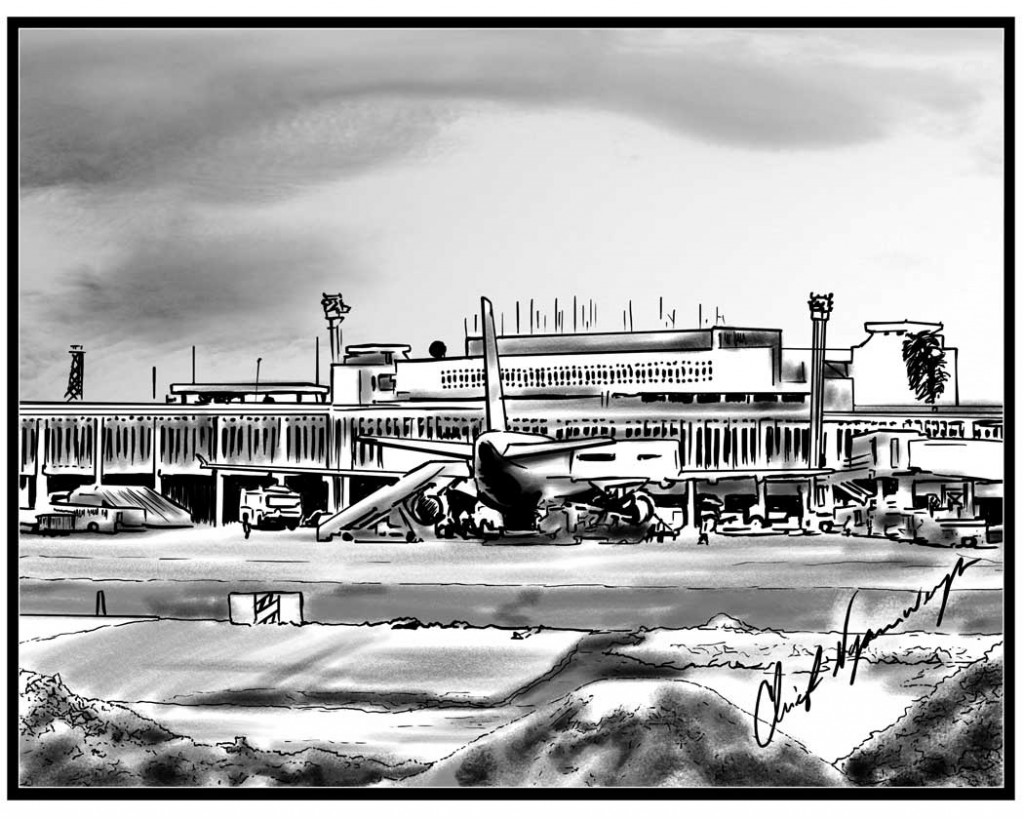
JKIA

Of Devil’s Armpits and International Airports.

In November 2011, CNN published its list titled “10 of the world’s most hated airports.” Our very own Jomo Kenyatta International Airport (JKIA) came in loud and proud at number 6, having been drubbed by London’s Heathrow, the Los Angeles International Airport and Paris’ Charles de Gaulle who came in third, second and first respectively. This is what the CNN report had to say:

“Saddled with a 1958 blueprint designed for 2.5 million passengers, JKIA receives close to twice that many. Hence the airport’s 2005, Three Phase, US$100 million expansion project which has seen long delays (something about the rain) and has been spinning its tires somewhere in Phase Two for the last few years. For now, that means business as usual: cramped spaces; long lines; inadequate seating; frequent power outages; tiny washrooms hiding up several flights of stairs; shabby duty free shops; overpriced food outlets; and business class lounges worthy of a shelter in mid-city Los Angeles. Sure, it’s a breeze compared to Lagos. But it could be so much better.”
To some, the mere fact that we even got cited as a global airport worth mentioning would perhaps provide some twisted sense of pride that we feature –notoriously I might add- on global indices. However, you just have to walk inside the main terminal past the 14 or so departure and arrival gates to know that the CNN reporter wasn’t giving short shrift to the state of the airport in their analysis. If anything they simply ran out of space to paint the complete picture. Luckily I have the luxury of a little more space.
The duty free shops are nothing but stuffy, untidily designed retail spaces that almost all sell the exact same items, which are displayed in the exact same way. Potential customers are engulfed by piles of unidentifiable stock that is packed to the rafters on thin display shelves jutting out against glass and aluminium framed shop walls thus providing a classic scene for a claustrophobe’s worst nightmare.
Passengers with long transit times curl prostrate on the ground, desperately trying to catch a few winks of sleep on the hard, terrazzo floors as arriving passengers gingerly pick their way over slumbering bodies to make their way to the immigration counters. The washrooms have to have been designed with petite, sprightly monkeys in mind, as those are the only mammals that can possibly navigate with regular ease the bizarre staircases and two feet wide cubicles that make up the lavatories. To the Kenya Airport Authority’s credit though, they have made an attempt to keeping them clean. So on my Lavatory Standard measure of cleanliness I’ll give JKIA three out of five stars – where one star equates to “the devil’s armpit” and five stars equate to “worthy of worship”.
Ladies and Gentlemen of the cabinet in the government: The government can’t manage the airport, build four lane highways, create a port in Lamu and whatever other grandiose targets we have for our aggressive vision 2030. We lack the capacity to do it and should concession it out to experienced and profit motivated airport operators who can run it like the business that it is. Kenya is no longer a piddling, little rural backwater represented as a blip on the former-colonies-we-used-to-have map in Buckingham Palace. Kenya is a vibrant growing economy, has the geographical benefit of being strategically located mid point of the African continent and has a reasonably well-educated citizenry that would make a good labor force for foreign direct investment. Sadly, the first impression a visitor gets on arriving at JKIA is one that is quite evidently at great odds with the rest of the infrastructural development going on in the country. Last week, I had the pleasure of transiting through Mumbai’s Chhatrapati Shivaji International Airport. I passed through it last in June 2006 and it was ghastly to transit through as it ranked head to head with JKIA in terms of decrepit facilities. [On my Lavatory Standard, it definitely was a one star then] Turns out that a few months earlier in February, a consortium of three companies trading as Mumbai International Airport Limited was appointed to carry out the modernization of Mumbai Airport.
And modernize they did. Last week, I walked through spaciously wide boulevards of shopping space done in an open plan design, with French and American fashion houses retailing the latest in perfumery and clothes. There was a food court with KFC, Pizza Hut and local fast food and coffee shops as well as the British high street retailer WHSmith with a little outlet tucked into a corner. You cannot be blamed for thinking you were in a European airport. This transformation occurred in the last five years. The immigration officer who gave me a toothy smile as he stamped my passport informed me that they handle at least 8,000 passengers during the day and another 12,000 passengers at night.
The airport has five operating terminals spread over an operational area of 1,450 acres (5.9 km2) and is India’s and South Asia’s largest and most important airline hub; it handled more than 29.9 million passengers in 2010–2011. While this may be almost 6 times JKIA’s passenger traffic of 5.6 million in 2010, our economic growth prospects make such numbers quite attainable as does our vision to firmly stamp our position regional business hub. [On another note, 1,450 acres for an airport should make anyone in greater Syokimau nervous right about now] I do have to admit though that the Lavatory Standard for the Mumbai airport has only moved two notches to 3 stars. They really do need to get the cleaners to do their job instead of staring blankly at the bathroom walls in abject boredom.
We have to do something about our airport if we plan to be an economy to reckon with. It’s dreadfully archaic. The good news is it’s at least better than Lagos and Kinshasa if my colleagues are to be believed!

[email protected]
Twitter: @carolmusyoka

How David’s little house brought the Goliath financial industry down

40 year old David Thomson, a librarian at the Fort Lauderdale Public Library, slowly shuts the door of his 3 bedroom bungalow, for the last time. The house, in a largely middle class suburb of Fort Lauderdale City has been home to him, his wife and 2 children for the last 5 years. Behind him, the CTS Bank official is nailing a Foreclosed Sign on the front lawn. The Thomson family immediately becomes a statistic: one family out of the 1.2 million residential home foreclosures so far in 2008. 3000 miles away on Wall Street, Bryant Weill, a hedge fund manager at Bear Stearns, shuts the door to his corner office for the last time following the financial collapse of the X year old firm. He drives back to his $1 Million mortgage free home in his S Class Mercedes Benz to tell his wife that he is now jobless. David and Bryant have never, and will probably never meet each other in their lifetime, but their lives are inextricably intertwined in a financial web so convoluted as to almost bring the global financial wheels to a halt.
The US mortgage market is multiple strata cake, beginning with the mortgage borrower such as David Thomson, who walks to his bank that forms the first layer termed as a primary mortgage provider, CTS Bank. David’s bank has one principle objective: to make money and by lending money to David, ties up valuable liquidity in a long term loan. To release this liquidity to enable more lending, the bank goes to the second layer, a secondary mortgage provider (such as Fannie Mae), who buys its mortgage loan book at a discount. A simple example would be $100m worth of mortgage loans would be sold at $90M, a price of 10%. The bank sells the right to receive the interest and principal on these loans to the secondary mortgage provider and in return receives $90M of cash that it can use to lend out again.
Enter the ubiquitous Wall Street Players as the third layer. Investment banks take a number of the mortgage loan books that the secondary mortgage provider has purchased and packages them into a security known as Mortgaged Backed Assets (MBAs). Wall Street monetizes the credit spread between the original mortgage taken by David Thomson and others like him and the yield demanded by bond investors through the bond issuance of the MBAs. The MBAs will therefore have several thousand underlying mortgages that have been packaged into the instrument. The icing on this jelly based cake are the institutional investors such as banks, hedge funds and insurance companies who have bought the Mortgage Backed Assets
The pricing of these assets takes a variety of elements into consideration such as the underlying borrower credit risk (in this case David Thomson’s capability to repay the loan), interest rate risk – the very real risk that if interest rates drop David Thomson will want to refinance his loan at a lower rate of interest, and prepayment risk – where David, in a lower interest rate environment can get a lower fixed rate loan from another bank and uses this to pay off (prepay) CTS Bank. To compensate investors for the prepayment risk associated with these bonds, they trade at a spread to government bonds. By first quarter of 2006 there were $6.1 trillion of traded MBS in the market.
So how did the cake start to sink? The financial innovation of the American retail financial industry led to the creation of sub-prime mortgages that were encouraged during the Clinton administration which began to put pressure on secondary mortgage market players such as Fannie Mae to expand mortgage loans to low and moderate income borrowers, who did not necessarily have a good credit history. Sub-prime borrowers are individuals who have a weak credit history and the lending bank does not perform verification of assets or income when lending. Subprime borrowing was a major contributor to an increase in home ownership rates and the demand for housing. The overall U.S. home ownership rate increased from 64 percent in 1994 (about where it was since 1980) to a peak in 2004 with an all time high of 69.2 percent.
Between 1997 and 2006, American home prices increased by 124%. Some homeowners used the increased property value experienced in the housing bubble to refinance their homes with lower interest rates and take out second mortgages against the added value to use the funds for consumer spending. U.S. household debt as a percentage of income rose to 130% during 2007, versus 100% earlier in the decade. Overbuilding during the boom period eventually led to a surplus inventory of homes, causing home prices to decline beginning in the summer of 2006. Easy credit, combined with the assumption that housing prices would continue to appreciate, had encouraged many subprime borrowers to obtain adjustable-rate mortgages (ARMs). These were mortgages that would have low teaser rates for borrowers, some even offering zero interest for one year. What was hidden in the fine print was that the loan repayments would triple and in some cases quadruple by the time the second year of the mortgage arrived. One borrower moved from paying $350 per month for her house to $1500 per month by the second year! Many homeowners were unable to re-finance and began to default on loans as their loans reset to higher interest rates and payment amounts.
The numbers are simply mind boggling. In a $12 trillion mortgage market by August 2008, 9.8% of the loans were in default and over 8.8 million homeowners had seen the value of their houses drop below the mortgage value. With over 1.7 million mortgage foreclosures in 2007, housing prices continued to tumble in 2008. The situation was further exacerbated by re-adjustments of Adjustable Rate Mortgages as per the fine print, and loan repayments shot up beyond borrower’s disposable incomes. David Thomson and many like him chose to walk away from their houses, finding it easier to pay rent than to pay a mortgage for $500,000 when the house was valued at $250,000. The institutional investors (both American and international) that had bought the mortgage backed assets suddenly found that they were holding useless securities, as there were no payments being made by the borrowers thereby ensuring that the interest –and most likely the principal- payments would not be received. The global inter-bank market subsequently imploded as Banks did not know each other’s exposure to the assets and whether the borrowing bank would have the liquidity to repay the inter-bank loans.
Without liquidity, banks cannot lend to their customers and they began falling like dominoes, 150 year old Washington Mutual declared bankruptcy in September 2008 and the US Government paid over $85 billion dollars to acquire a 79.9% stake in the world’s largest insurer AIG that had significant exposure in mortgage related securities. Investment Banks such as 80 year old Bear Stearns and 158 year old Lehman Brothers, who were the arrangers and underwriters – banking speak for guaranteeing the sales of- the securities had their entire capital bases wiped out as institutional investors furiously back pedaled and demanded their money back. This resulted in the investment bank’s shotgun purchases by competitors. And for the first time since the Great Crash of 1929, capitalism took a beating and Western governments beginning with the US, followed by the UK and Germany, stepped in to bail out and some may even say nationalize cornerstone institutions. Karl Marx must have rolled in his communist grave with vindication!
So as Bryant Weill starts forming the conversation in his mind that he will have with his wife about how they now have to live on his $5m savings made from his bonuses from superb sales of mortgage backed assets, David Thomson, whose savings were wiped out to pay off a paltry amount of the mortgage, drives away to his 2 bedroom rented apartment berating himself for the umpteenth time for listening to the smooth talking mortgage advisor at CTS Bank, who promised that the Adjustable Rate Mortgage would not change his life. And by August 2008, financial institutions globally had chalked up over $501 billion in losses. The Goliath global financial industry was brought down to its knees by the mwananchi David who only aspired to own his own home.